

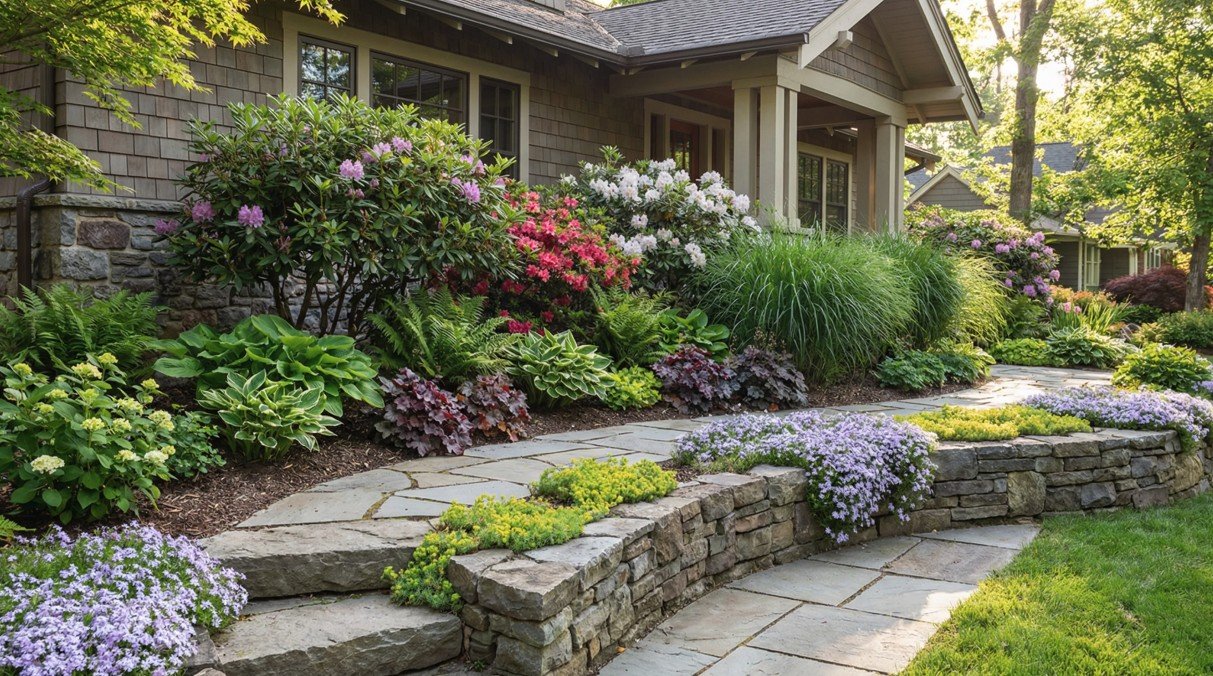
How far should plants be from foundation walls? Home foundation plants should be at least three to four feet from the home foundation, while larger shrubs should be five feet or more away, depending on the mature size plants will reach.
To determine how far off the foundation you should plant a small tree, take the mature canopy width of the tree and divide it in half. For example, a small flowering crabapple might reach a mature width of 15’ wide. Crabapples should therefore be planted at least 7.5’ off the foundation.
Spacing is not just about appearance. It affects moisture control, airflow, root growth, and long-term maintenance. When shrubs and trees are planted too close, they can trap water against the house, crowd the siding, and create extra work in the future.
This guide provides guidelines for how far different plants should be from your foundation, based on mature size and growth habits.
Use Your Vision, Not Your Sight
Good landscaping starts with thinking about what your plants will look like years from now.
Dr. Larry Kuhns, professor of ornamental horticulture at Penn State, always urged his students to “use your vision, not your sight.”
What does that mean? It means that when you design and install a landscape, you must “use your vision” to visualize the future size of those plants and space them accordingly. You will have major problems if you only use your “sight”, which just tells you how that plant looks today.
For example, let’s say you really like the look of a ‘Green Giant’ arborvitae. You pick it up at the nursery, and it’s only one foot wide. So little and cute! You take it home and plant it three feet from your foundation.
Well, guess what… Green Giants put on about 3’ of growth per year. Yep. In just a year, your plant will be touching the house. That’s a problem!
So what should you do instead? You can either right-size the plant selection by picking a very narrow plant that fits the location (think ‘Graham Blandy’ boxwood, with a 1-2’ mature diameter), or you can right-size the plant location by finding an area where your Green Giant can grow as nature intended.
Before you plant anything, stop and ask yourself. How far should plants be from the foundation once they reach full size?
The goal is simple. Put the right plant in the right place.
“I’ll Just Hack It Back”
Why does it matter if my plants get too big?
We’ve heard it too many times to count… “If the plant gets too big, I’ll just hack it back!”
(This is when landscape professionals start to shudder and cringe.)
That sounds reasonable at first. In practice, it rarely works well.
Would you expect a Great Dane puppy to stay the size of a Bichon Frisé? Of course not! There is a lot to be said for respecting the natural tendencies of any living thing.
At Earthcraft, we prefer to design with the future in mind, rather than massacring plants year after year with hard pruning.
Plants forced into tight spaces need constant pruning. That repeated cutting stresses the plant and shortens its lifespan. It also adds ongoing maintenance costs.
If you are deciding how far plants should be from the foundation, remember that roots and mature width matter just as much as height.
At EarthCraft Landscaping, we design with the future in mind using a smart landscape solution by our 3D Design experts. Repeatedly cutting back an oversized plant to force it into a space it was never meant to occupy stresses the plant, shortens its lifespan, and increases long-term maintenance.
If the plant lover’s perspective doesn’t do it for you, let’s talk about money. When you pay a landscaper to hack back your shrubs once or twice a year, you’re wasting money on pruning that wouldn’t be necessary if you had put the right plant in the right spot. Plus, you’re paying them to shorten your landscape’s lifespan. It just doesn’t make good fiscal sense.
And finally, just because you hacked back the top of the plant, doesn’t mean you stopped its roots from growing. Plants that are installed too close to your home can root into the foundation, causing drainage problems and other structural issues. Nobody wants that.
Understanding Mature Size and Growth Rate
Every plant has a mature height and width. Nursery tags usually list both. The width is often the number that determines proper spacing from the house.
Growth rate also plays a role. A shrub that grows six inches per year may not seem aggressive. Over several years, that steady growth adds up.
Take panicle hydrangeas as an example.
Pinky Winky hydrangea can reach six to eight feet tall and wide. That size works well in a deep planting bed, especially when placed at least four feet from the foundation.
Little Quick Fire hydrangea offers a similar look but matures closer to three to five feet tall and wide. In tighter spaces, that smaller footprint makes it easier to maintain proper clearance.
The point here is: It pays to do your research.
Choosing the right variety makes answering how far plants should be from the foundation much simpler.
If you are still unsure about your landscape and planting design, EarthCraft Landscaping’s professional residential landscape experts can help.
Right-Sizing Your Plant Location
Don’t be too conservative when it comes to bed space. Ample-sized beds allow for layering of plants, providing the variety, color, texture, and multi-season interest that homeowners crave.
Designing Landscape Beds for Long-Term Success
Plant selection is only half of the equation. Bed design plays an equally important role.
Avoid being overly conservative with bed size. Generous beds allow for proper plant spacing and layering, which creates dimension, texture, seasonal interest, and visual balance.
As a general rule, foundation beds should extend at least five feet from the home. In a five-foot bed, plants that mature around four feet wide leave breathing room on both sides. Aim for at least six inches between mature foliage and the house, and another six inches between foliage and the bed edge.
Larger homes often benefit from deeper beds. Ten to twenty feet of depth in select areas allows for ornamental trees and larger shrubs without crowding the structure.
Does the size of your home make your landscape look small and sad? We see this a lot. A grand-scale home needs a landscape to match, and the daylilies and hosta just aren’t doing the trick.
As long as the beds are designed to give large-scale plants enough room to grow, you can feel comfortable selecting large specimens that bring your landscape up to scale with your home.
Step-by-Step Guide: How to Determine How Far Plants Should Be From the Foundation
Step 1: Measure Your Available Space – Start by measuring the area between your foundation and any walkways, driveways, or property lines. This determines which plants fit your landscape.
Step 2: Consider the Mature Size – Small shrubs should be planted at least 3 feet from the foundation of the house, while larger shrubs need 4–5 feet. The tree’s foundation distance should be at least half the future canopy width.
Step 3: Account for Root Systems – Plants placed too close can send roots into your foundation, causing cracks and moisture issues. Always research the root spread of your chosen varieties.
Step 4: Plan for Maintenance Access – Leave enough room to walk behind plants for window cleaning, painting, and foundation inspections.
Best Foundation Plants and Their Spacing Requirements
When selecting plants and shrubs for your foundation, consider both aesthetics and practical spacing needs:
Compact Shrubs (2-3 feet from foundation)
Compact shrubs like small varieties of hydrangeas, boxwoods, and extreme dwarf evergreens work well when planted 3 to 4 feet from the house. These foundation plants add color without aggressive root systems.
Medium Shrubs (4-5 feet from foundation)
Larger hydrangeas, bird’s nest spruce, and blue holly need slightly more room. Keep these shrubs planted at least 4-5 feet away from your home’s exterior.
Large Shrubs (6+ feet from foundation)
Spacing plants is a must when foundation planting. Large shrubs such as viburnums, burning bush, dwarf Japanese maples, and most junipers require 6 or more feet of clearance to prevent root damage and allow proper air circulation around your surrounding landscape.
Invest in a Landscape That Lasts
We Can Help
A well-planned landscape protects your home while improving curb appeal.
Designing a long-lasting landscape can feel overwhelming. That is where EarthCraft Landscaping comes in.
Our team applies these principles to create landscapes that are both beautiful and functional. Whether we’re designing residential or commercial landscaping projects, our focus is always on selecting the right plants, placing them correctly, and creating landscapes that remain healthy, attractive, and easy to maintain for years to come.
By putting the right plant in the right place, you’ve reduced the maintenance ahead of you and increased the life of your landscape, right out of the gate. Be aware, however, that your landscape still needs professional care. It’s not a “set it and forget it” type of investment.
Talk to our account managers today about how we can help ensure your landscape looks great for years to come.
Frequently Asked Questions
What Is the Most Common Mistake When Planting Near Foundations?
The most common mistake first-time gardeners make is planting too close to their house foundation. Many homeowners place shrubs a foot or two off the foundation not accounting for mature growth.
Within a few years, these plants crowd the foundation, trap moisture, and create pest pathways into the home. Always measure the expected mature width and add at least one to two feet of clearance. This protects both your plants and your home’s value over time.
Which Plants Should Stay Away from Your Foundation?
Certain plants pose risks when installed too close to your Blairsville home. Willow trees, silver maples, and bamboo have aggressive root systems that can crack foundation walls and invade drainage pipes. When installing foundation plantings, avoid these species within 50 feet of your home.
Instead, consider adding compact boxwoods, dwarf hydrangeas, ornamental grasses, and lots of herbaceous perennial for color. These options provide curb appeal without threatening your foundation’s integrity.
Keep shrubs away from the foundation to allow for air circulation and prevent moisture buildup.


